When Should My Child Start Learning to Write

Shop new arrivals
-
4th Grade Math Workbook for Ages 9–10 | Math Commanders
Original price was: $17.99.$11.99Current price is: $11.99. -
A Merry Bright Christmas Activity Book: 100+ Pages of Coloring, Puzzles, Mazes & Holiday Fun for Kids Ages 5+
$18.99$12.44 -
All the Love for Mom : A Mother’s Day Activity Book for Kids That Becomes a Keepsake
$16.99 -
America Through Time Travel — American History Activity Book for Kids | Coloring, Puzzles & Fun Facts
$18.99 -
America Turns 250: Activities, Puzzles, Coloring Pages, Fun Facts, and Amazing D
$18.99
Every parent hits this moment eventually.
You are watching your three year old scribble across a piece of paper with a crayon — completely absorbed, totally confident — and you start wondering whether you are supposed to be doing something more structured. Whether the child next door is already writing their name. Whether you are already behind.
You are not behind. But understanding what writing readiness actually looks like will help you stop guessing and start helping.
Writing Does Not Start With Letters
This is the part most parents miss.
Writing is a physical skill before it is an academic one. Before a child can form a letter, their hand needs to be strong enough to hold a pencil with control, coordinated enough to guide it in a specific direction, and experienced enough with lines and shapes to know roughly what a letter is supposed to look like.
None of that happens overnight. And none of it starts with the alphabet.
It starts with scribbling. Then drawing. Then tracing lines, curves, and shapes. Then copying simple patterns. Then — and only then — does letter formation make sense to a developing hand.
Skipping those earlier steps does not make a child a faster writer. It usually makes them a more frustrated one.
What the Research Says About Age
Developmental research is fairly consistent on this. Most children begin to show genuine writing readiness somewhere between the ages of three and five. But readiness looks different for every child, and age alone is not the deciding factor.
What matters more than age is whether the foundational physical skills are in place. Occupational therapists and early childhood educators look for a handful of signs before they consider a child ready for formal letter writing.
Can the child hold a crayon or pencil with their fingers rather than their whole fist? Can they draw a reasonably straight line across a page when they try? Can they follow a simple tracing guide without losing patience after ten seconds? Do they show any interest in making marks on paper at all?
If most of those answers are yes, the child is likely ready to begin tracing. If most of those answers are not yet, the most useful thing a parent can do is give the hands more time and more low-pressure practice before moving to structured writing.
What to Do Before the Pencil Comes Out
The activities that build writing readiness do not look like writing at all.
Playdough strengthens the small muscles in the hand that pencil control requires. Threading beads, using scissors, building with small blocks, peeling stickers, and drawing freely all contribute to the fine motor development that comes before letters.
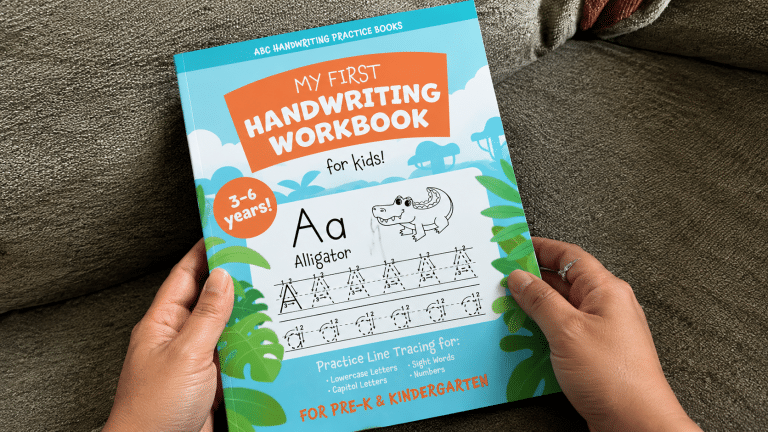
When a child moves into tracing, simple lines and shapes are more valuable than letters at first. A tracing book that works through curves, diagonals, and zigzag patterns before introducing any letters is doing exactly the right thing developmentally. The hand learns to move with control before it learns to move with accuracy.
Most children who struggle with letter formation in kindergarten are not behind intellectually. They simply needed more of this earlier work before they were asked to sit down and write.
What Writing Practice Should Actually Look Like
Short sessions work far better than long ones for children in this age range. Ten minutes of engaged tracing is worth more than an hour of a child going through the motions to make a parent happy.
The books that hold a young child’s attention long enough to be useful are the ones that make every page feel like something is happening. An animal appears when the letter is finished. There is a character to follow. The activity leads somewhere. That engagement is not just nice to have — it is what builds the repetition that creates real skill.
Themed workbooks work especially well for this reason. A child who is tracing letters with a dinosaur on every page will come back tomorrow. A child who is filling in plain dotted lines will not.
The One Thing Worth Remembering
Writing readiness is not a date on the calendar. It is a collection of small physical skills that build on each other quietly over time.
Your job as a parent is not to push the process forward. It is to support the steps that make the process feel natural when it arrives.
Start with the hands. Build the strength. Make the tracing fun. And trust that the letters will follow.