Why This Book Work Better Than Grammar Drills
Most people who start learning Japanese hit the same wall around month three.
They know their hiragana, they have memorized a handful of verb conjugations. They can tell you that は marks the topic and が marks the subject. And yet the moment they try to read an actual Japanese sentence or understand a native speaker, everything falls apart.
The grammar knowledge is real. The ability to use it is not. And that gap is the reason most beginners eventually stop.
Why Grammar Study Alone Does Not Build Fluency
Grammar study teaches you the rules of a language. It does not teach you the language.
There is a fundamental difference between knowing how Japanese works and actually knowing Japanese. The first lives in the part of your brain that processes rules and systems. The second lives in the part that processes patterns, context, and meaning absorbed through repeated exposure over time.
Researchers call this the difference between explicit and implicit learning. Explicit learning is what happens when you study a grammar point and consciously apply it. Implicit learning is what happens when your brain absorbs patterns through repeated meaningful exposure the same way you learned your first language as a child.
Grammar drills build explicit knowledge efficiently. But fluency is built on implicit knowledge. And the most effective way to build implicit knowledge in any language is through comprehensible input reading and listening to real language at a level you can mostly understand, where your brain absorbs patterns naturally rather than studying them deliberately.
This is why Japanese short stories for beginners are not just a supplementary resource. For many learners they are the most productive thing they can do with thirty minutes of study time.
Recommended products
-
Japanese Short Stories for Beginners | Learn Japanese Naturally
$19.99 -
Learn Japanese With Yumi – Japanese Short Stories for Beginners
Original price was: $21.99.$15.99Current price is: $15.99.
What Happens Inside Your Brain When You Read a Story in Japanese
When you encounter a word inside a compelling story during a moment of tension, humor, or genuine cultural curiosity your brain encodes it differently than it would from a vocabulary list.
The word arrives attached to a memory. A scene. A character. An emotion. And memories formed with emotional or contextual weight are stored more durably than memories formed through repetition alone. This is why you can remember the plot of a book you read years ago but struggle to recall the vocabulary list you studied last week.
Japanese short stories for beginners work on exactly this principle. Instead of encountering 食べる as entry 47 in a vocabulary drill, you encounter it in a sentence about a character standing in front of a convenience store deciding what to eat for lunch. The word lands in context. The brain holds on to it.
The Specific Advantage of Reading at Beginner Level
The key phrase is comprehensible input content at just above your current level where you can understand most of what you are reading with some effort. Too easy and no learning happens. Too difficult and the brain disengages.
Well-written Japanese short stories for beginners sit in exactly this range for N5 to N4 level learners. The vocabulary is practical and contextual rather than textbook formal. The sentence structures appear repeatedly across different stories so patterns accumulate naturally. Bilingual vocabulary lists after each story let you check your understanding without breaking the flow of reading.
This approach builds something grammar drills cannot a sense of how Japanese actually feels to read. The rhythm of a sentence. The way a particle shifts the meaning of a phrase. The texture of spoken Japanese as it appears on the page. These things do not come from memorizing conjugation tables. They come from reading.
Where to Start as a Beginner
The most common mistake beginners make when they decide to start reading Japanese is going straight to native content. Manga without furigana. Novels written for adult Japanese speakers. News articles dense with kanji.
Native content is the goal. It is not the starting point.
The right starting point is a collection of Japanese short stories written specifically for beginners — stories grounded in real Japanese life, presented with bilingual vocabulary support, and structured to build JLPT N5 to N4 reading confidence through genuine engagement rather than grinding through exercises.
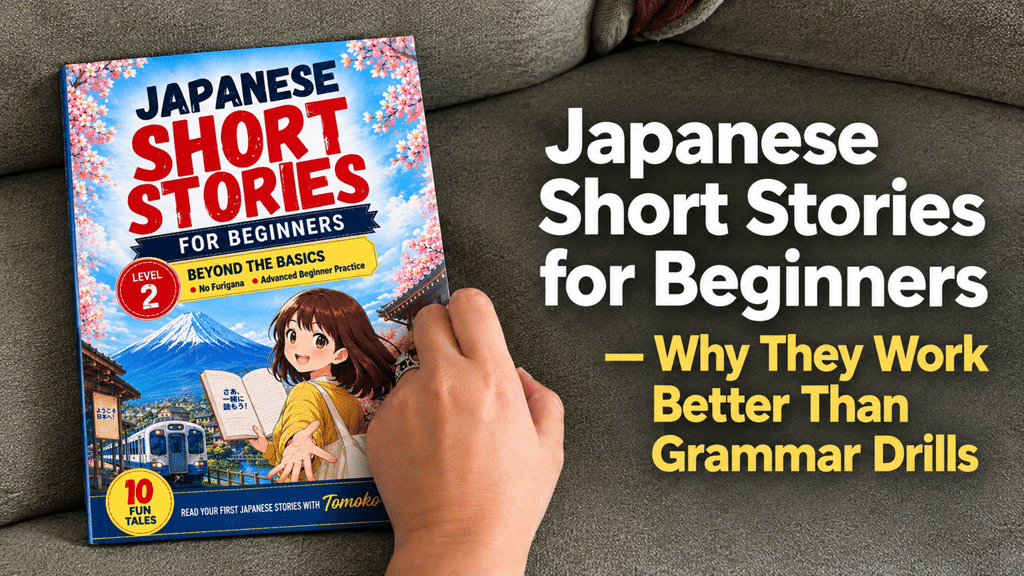
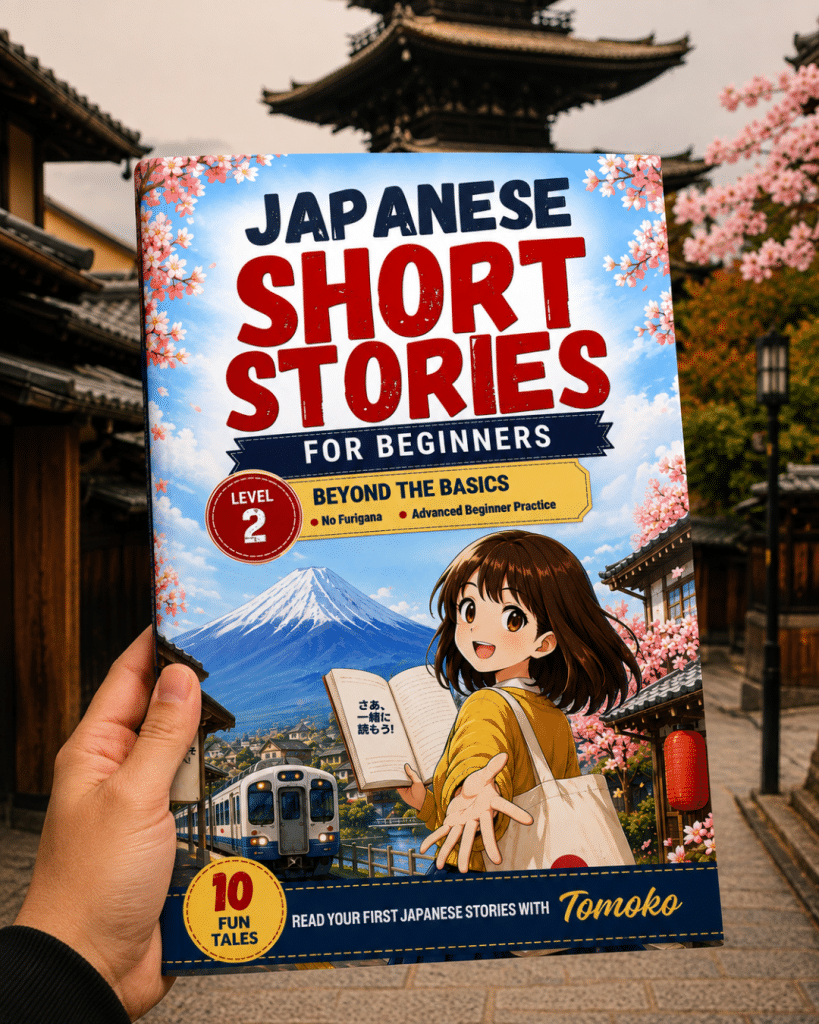
Japanese Short Stories for Beginners from Epic Journeys Publishing follows Tomoko through ten moments of everyday Japanese life from gachapon machines and convenience store lunches to cat cafés and moving house. Each story is written in natural Japanese with an English translation, bilingual vocabulary list, chapter summary, and comprehension quiz.
It is the reading practice that grammar drills were never designed to provide.
Related Products
-

Don’t Quote Me on That: Discover the Origins and Meanings of English Idioms
$20.00 -
Italian Short Stories for Beginners | Learn Italian Through Real Stories
$20.99$16.57 -
Japanese Short Stories for Beginners | Learn Japanese Naturally
$19.99 -
Learn Japanese With Yumi – Japanese Short Stories for Beginners
Original price was: $21.99.$15.99Current price is: $15.99.