You’ve mastered the swipe, the scroll, and the shortcut. You can type 80 words per minute without looking up. But when was the last time you actually wrote something by hand — and felt better for it?
Cursive handwriting might feel like something your grandparents did, but neuroscience disagrees. Writing by hand — especially in cursive — activates parts of the brain that typing simply does not. And for young adults navigating full schedules, information overload, and digital burnout, the case for picking up a pen has never been stronger.
Why Cursive Writing Is the Ultimate Brain Hack for Young Adults
Here’s what the research actually says — and why the benefits of cursive writing go far beyond the page.
1. Cursive Writing Activates Your Brain in Ways Typing Can’t
Research from the Norwegian University of Science and Technology, published in Frontiers in Psychology, found that handwriting engages up to 14 distinct areas of the brain simultaneously — including regions responsible for memory recall, visual attention, concentration, and fine motor coordination.
Typing, by contrast, is a repetitive keystroke pattern that bypasses much of this neural engagement. When you write in cursive, your brain has to form each letter intentionally, which strengthens the connections between thinking and doing.
For young professionals who spend their days context-switching between apps and notifications, this kind of focused neural engagement is increasingly rare — and increasingly valuable.
What This Means for You
Writing your goals, ideas, or to-do lists by hand — rather than typing them — can improve how well you encode and retain that information. If you’re studying, planning, or trying to think through a big decision, the pen is a more powerful tool than you think.
2. Handwriting Reduces Stress and Supports Mental Health
There’s a reason journaling has made a massive comeback among Gen Z and millennials. Writing by hand slows your thoughts down to a pace your hand can follow — and that friction is actually the point.
Studies show that expressive handwriting — including letters, gratitude lists, and reflective journaling — reduces symptoms of anxiety and depression, and improves overall mood. Research from UC Berkeley found that writing letters of gratitude had measurable mood-enhancing effects that lasted well beyond the writing session itself.
In a world where stress is the default, picking up a pen and writing slowly is a form of nervous system regulation that costs nothing and requires no app, no subscription, and no wifi.
The Mindful Writing Advantage
Cursive handwriting in particular has a meditative quality. The connected, flowing strokes demand presence — you can’t zone out the way you can while typing. Think of it as mindfulness with a pen: each word becomes a small act of intention.
3. Writing by Hand Helps You Sleep Better
If you’re reaching for your phone before bed, you’re not alone — but it’s costing you more sleep than you realise. Screens emit blue light that disrupts your circadian rhythm, but it’s not just about the light.
A study published in Psychology Today found that writing a to-do list for the following day before bed — by hand — helped people fall asleep approximately 9 minutes faster than those who wrote about completed tasks. The act of writing your intentions down offloads mental clutter from your brain, making it easier to switch off.
Swap the scroll for a notepad tonight. Your sleep quality will thank you.
4. Handwritten Communication Still Stands Out — Professionally and Personally
In a culture of instant messages and automated replies, a handwritten note lands differently. It signals effort, intention, and care in a way that no emoji or templated email can replicate.
For young professionals building networks, expressing gratitude to mentors, or staying in touch with people who matter — a handwritten card or letter creates a lasting impression. It tells the recipient that you took time. And in an economy where time is the scarcest resource, that matters enormously.
Personally, the effect is even more powerful. Handwritten messages between friends and family carry an emotional weight that digital communication simply cannot match. They become keepsakes. Screenshots don’t.
5. Cursive Handwriting Builds Focus in a Distracted World
Attention is the new currency — and it’s being spent faster than ever. Notifications, feeds, and infinite scroll have collectively shortened our ability to sit with a single task.
Cursive handwriting demands sustained focus. You cannot rush it. The very act of slowing down to form connected letters trains your attention in a way that feels almost countercultural right now — and that’s precisely why it works.
Young adults who practise handwriting regularly report improved concentration, reduced anxiety, and a greater sense of calm — not because it’s nostalgic, but because the brain responds to it as a form of active, intentional rest.
How to Start: Simple Cursive Writing Habits for Young Adults
You don’t need to overhaul your routine to get the benefits of cursive writing. Start small and let the habit build naturally:
• Write your daily to-do list by hand instead of in an app
• Keep a bedside notebook for evening brain dumps before sleep
• Send one handwritten card or letter per month to someone you value
• Start a gratitude journal — three things, written in cursive, every morning
• Use a cursive handwriting practice workbook to rebuild the skill with purpose
• Write slow, intentional notes in meetings rather than typing
The Bottom Line
Cursive writing isn’t a relic. It’s a skill with real, research-backed benefits that are especially relevant for young adults managing stress, building focus, and looking for offline anchors in an increasingly online world.
Write slowly. Think clearly. Connect more deeply. The benefits of cursive writing are waiting on the other side of a blank page.
✍️ Ready to start your handwriting practice?
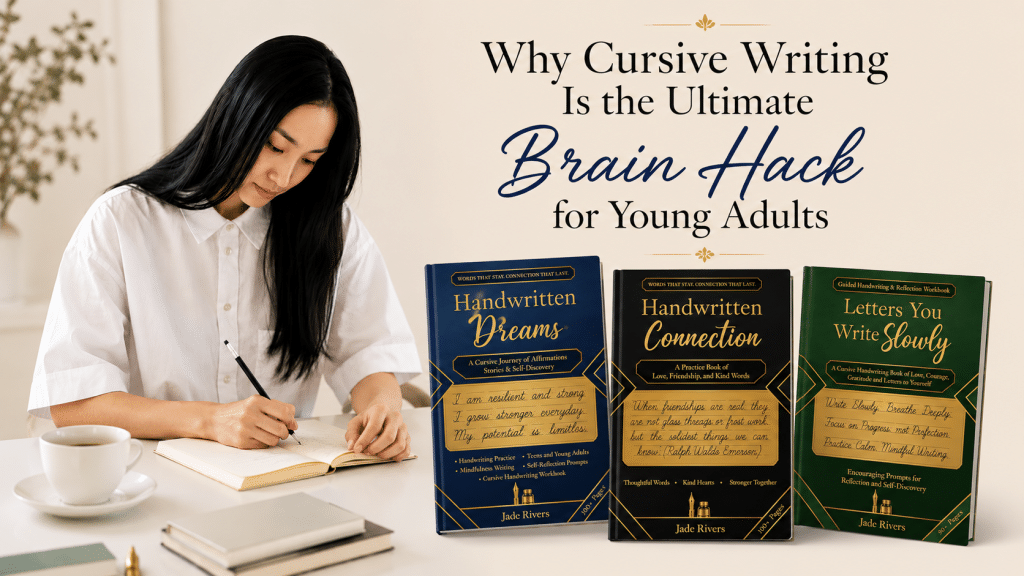
Handwritten Connection by Jade Rivers (Epic Journeys Publishing) is a cursive handwriting practice workbook designed for adults and teens who want to slow down, write with intention, and reconnect through heartfelt words. With guided tracing, love letters, gratitude prompts, and mindful writing pages — it’s the perfect place to begin.