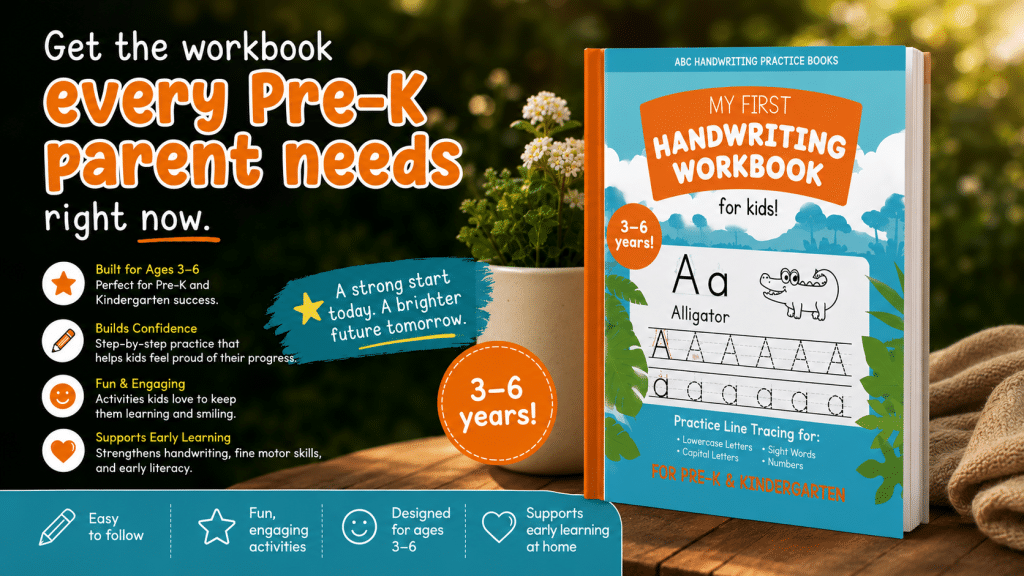
Why Tracing Books Are the First Step to Strong Handwriting
There is a moment every parent recognizes. Their child picks up a crayon for the first time, grips it with a full fist, and drags it across the page with absolute confidence. It is joyful. It is messy. And it is the very beginning of one of the most complex motor skills a human being will ever learn.
Handwriting is not simply putting letters on paper. It is a full-body neurological event — one that takes years to develop and requires a very specific kind of practice to get right. And according to a growing body of developmental research, tracing is not just a warm-up exercise. It is the most effective first step a young child can take toward strong, fluent handwriting.
Here is why.
The Brain Learns by Doing — And by Watching Itself Do It
Before a child can write a letter independently, the brain needs to build what researchers call a motor memory for that shape. This is not a metaphor. It is a literal neural pathway — a sequence of muscle movements that, with enough repetition, becomes automatic.
The challenge is that asking a young child to produce a letter from scratch is neurologically overwhelming. They have to simultaneously:
- Remember what the letter looks like
- Translate that visual memory into a movement plan
- Execute that plan with a hand that has limited fine motor control
- Evaluate whether the result matches their intention
- Correct and try again
That is an enormous cognitive load for a brain that is still developing in nearly every area at once.
Tracing removes most of that load. The path is already there. The child’s only job is to follow it — and in doing so, they are etching that movement sequence into muscle memory with every single stroke. Research into motor learning consistently shows that guided movement practice accelerates the formation of procedural memory far more efficiently than unguided attempts, particularly in early childhood when the prefrontal cortex — responsible for planning and error correction — is still years away from full development.
The Hand-Brain Connection Is More Powerful Than Most Parents Realize
One of the most well-supported findings in developmental neuroscience is that fine motor activity directly stimulates cognitive development. The hands and the brain are not separate systems — they are deeply integrated. The motor cortex, the sensory cortex, and the language processing regions of the brain are all activated simultaneously during handwriting practice.
This means that when a child traces the letter A, they are not just practicing a motor skill. They are also:
- Strengthening neural connections associated with letter recognition
- Building the foundational circuits for reading comprehension
- Developing the hand strength and coordination that underpins all future writing
Studies comparing children who received early handwriting instruction with those who did not consistently find that the handwriting group demonstrates stronger letter recognition, faster reading acquisition, and better spelling performance — even when the groups are matched for general intelligence and language exposure.
The act of forming a letter by hand appears to encode it in the brain in a way that simply looking at it does not. Tracing is the safest, most developmentally appropriate way to begin that encoding process.
Fine Motor Development Has a Window — And It Opens Early
Child development research has identified what is called a sensitive period for fine motor skill acquisition. This window opens around age two and reaches its most receptive phase between ages three and six — precisely the years most children spend in preschool and kindergarten.
During this window, the brain is building the neural architecture for precise hand movements at an accelerated rate. Myelin — the insulating sheath that speeds up nerve signals and makes movements faster and more reliable — is being laid down rapidly across the motor pathways. Activities that challenge and engage these pathways during the sensitive period produce gains that would take significantly longer to achieve later.
This does not mean children who miss early fine motor practice cannot learn to write. They absolutely can. But the research is clear: early, structured fine motor engagement produces faster, more durable results than the same engagement introduced at a later age.
Tracing books are one of the most accessible and effective tools for engaging this window. They provide:
- Consistent, repeatable practice in a low-stakes environment
- Natural progression in difficulty as the child’s control improves
- Immediate visual feedback on whether the movement matched the target
- A satisfying, tangible result that motivates continued engagement
Grip and Posture: The Foundation Before the Letter
Something tracing books develop that is rarely talked about — but critically important — is pre-writing posture and grip.
Before any letter can be written well, a child needs to develop:
- Tripod grip — holding the pencil between thumb, index, and middle finger
- Wrist stability — keeping the wrist anchored while the fingers move
- Core stability — sitting upright with enough trunk strength to allow arm freedom
- Shoulder girdle control — the ability to move the arm with precision from the shoulder
These are not skills children are born with. They develop through practice — and tracing, done regularly with a pencil or crayon on paper, builds all four simultaneously.
Occupational therapists who work with children experiencing handwriting difficulties frequently report that the root cause is almost never intelligence or effort. It is almost always inadequate fine motor foundation — the kind that is built through exactly the sort of guided, repetitive hand movement that tracing provides.
Tracing Builds Confidence — And Confidence Builds Writers
There is a psychological dimension to early handwriting development that the research supports clearly: children who experience early success with letter formation are significantly more likely to engage voluntarily with writing tasks as they progress through school.
This is not a trivial finding. Motivation and self-efficacy — a child’s belief in their own ability to succeed at a task — are among the strongest predictors of academic achievement that researchers have identified. A child who believes they are a writer will write more. A child who writes more will improve faster. And the cycle compounds.
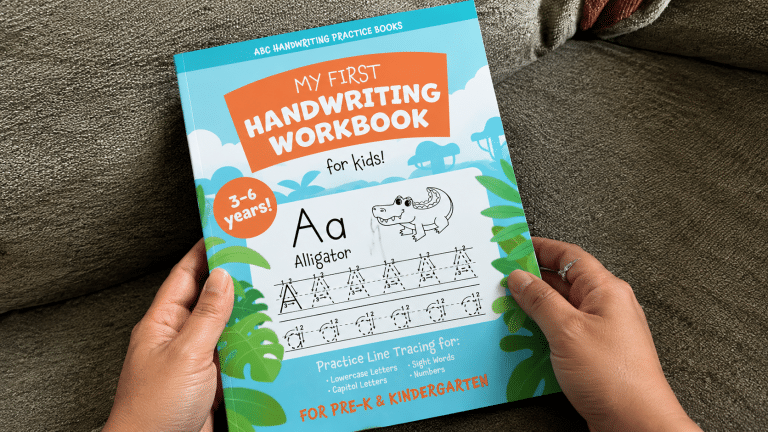
Tracing books are uniquely positioned to create this early success experience. Because the template is already there, even a child with limited fine motor control can produce a result that looks recognizably like the target letter. That small success matters enormously to a three or four year old. It says: I did this. I can do this.
What the Research Says About Digital vs. Paper Tracing
With the rise of educational apps, many parents wonder whether tracing on a tablet screen produces the same benefits as tracing on paper. The research on this question is still developing, but the early findings consistently point in the same direction:
Paper wins.
The reasons appear to be both sensory and mechanical. When a child traces on paper, they receive tactile feedback — the resistance of the paper, the texture of the page, the drag of the pencil. This multisensory input appears to enhance memory encoding and motor learning in ways that the smooth, frictionless surface of a touchscreen does not replicate.
Additionally, the physical weight and grip of a pencil or crayon engages the hand musculature in ways that swiping a finger or stylus across glass does not. The development of hand strength and fine motor control that underpins strong handwriting requires real physical resistance — and paper provides it.
This does not mean educational apps have no value. But for the specific goal of building handwriting foundations, paper-based tracing practice remains the gold standard according to the available evidence.
Practical Takeaways for Parents
If you want to give your child the strongest possible start with handwriting, here is what the research supports:
Start early. The sensitive period for fine motor development is ages three to six. You do not need to wait for formal schooling to begin.
Keep sessions short. Young children’s attention spans are limited, and fine motor work is cognitively demanding. Ten to fifteen minutes of focused tracing practice is more effective than an hour of frustrated scribbling.
Choose paper over screens. The tactile feedback of pencil on paper produces better motor learning outcomes than digital alternatives.
Make it multisensory. Let your child say the letter aloud as they trace it. The combination of motor, visual, and auditory input strengthens the neural encoding of each letter.
Celebrate the process, not just the result. A child who enjoys tracing will trace more — and more practice produces better outcomes than any single session of perfect technique.
Progress gradually. Good tracing books introduce uppercase letters first, then lowercase, then numbers, then words — matching the natural progression of fine motor development.
The Bottom Line
Tracing is not a shortcut or a crutch. It is developmentally appropriate, neuroscience-backed preparation for one of the most demanding cognitive and physical tasks we ask young children to perform.
The research is consistent and clear: children who engage in structured tracing practice during the preschool years develop stronger handwriting, better letter recognition, and more confident attitudes toward writing than those who do not.
The first mark a child makes on a traced letter is the first step in a journey that leads to essays, stories, letters, notes, and a lifetime of written expression.
That first step matters. Make it count.
Epic Journeys Publishing creates educational books designed to give every child a confident, joyful head start in learning. Explore our collection at your favorite book retailer.
Recommended products
-
France Activity Book for Kids | Paris Travel Journal Ages 6–11
$18.99$14.99 -
Sight Word Workbook for Kids Ages 4–9 | My First Sight Word Adventure
$17.99$11.79 -
The England Adventure Activity Book
$18.99$14.99 -
The Greece Adventure Activity Book
$18.99$14.99